Showing posts with label astrophysics. Show all posts

Friday, July 15, 2016

First results from Sardinia Radio Telescope

Are you going to visit Sardinia this summer?
If you arrive at the Airport of Cagliari from NE, probably you will see a strange 64-meter diameter white instrument
in the middle of (almost) nothing.


What it is that?  Keep calm: aliens are not arrived yet. Your holidays are probably save. 
This is the Sardinia Radio Telescope,
a major radio astronomical facility almost ready for outstanding scientific observations. 
Its science goals spread from Radio Astronomy, Geodynamical studies and Space science.

You do not trust me?
Here the  first scientific result from observations  with this extraordinary facility, published on
Monthly Notices of the Royal Astronomical Society:

https://arxiv.org/abs/1607.03636 

They observed a supermassive black hole 
moving at high velocity to a nearby galaxy cluster  3C129.
Here also a brief description of the obtained results from Matteo Murgia (in italian). 

Waiting for other exciting news from the SRT team! 


Thursday, April 24, 2014

The first observed SMBHB?

An artistic illustration of black hole
SMBHB stands for Super Massive Black Hole Binary. If the results get confirmed, this shows that we have observed inactive SMBHBs for the first time ever! SMBHs can be 10^7 times more massive than our own Sun. The Sun is one million times more massive than the Earth. The mass of Earth is about 10^24 kg, by the way.

SMBHBs can be used as excellent natural labs for testing many aspects of gravitational and high-energy physics. As you might know already or might just guess from the term "black hole", a black hole cannot be seen by our usual optical telescopes (not even by other common types of telescopes in other ranges of frequencies of electromagnetic waves such as radio-telescopes and x-ray telescopes). A black hole is such a massive object that even light cannot scape from its gravitational field. That’s also why you can not see a black hole, simply because neither light nor other electromagnetic waves can scape from the gravitational field of a black hole and reach your eyes. The only way to observe black holes is studying their gravitational field effect on the motion of nearby stars. An even better way to study and observe these inconspicuous giants is listening to them! (check out this note to see how) They are pretty loud!

To check out more details about this first serious candidate of SMBHB at the galaxy SDSS J120136.02+300305.5, see the original article, published recently at The Astrophysical Journal: F. K. Liu et al. 2014 ApJ 786 103.

Thursday, December 26, 2013

Measuring a black hole mass - you're doing it right


  1.  The orbit of every planet is an ellipse with the Sun at one of the two foci.
  2. A line joining a planet and the Sun sweeps out equal areas during equal intervals of time.
  3. The square of the orbital period of a planet is proportional to the cube of the semi-major axis of its orbit.
Kepler's laws are among the most fundamental laws of astronomy.
Basically, they describe the orbits of planets around the Sun (or any "small" object around a much more massive central object), under the assumption that the gravitational field can be considered Newtonian (even if historically quite the opposite happened, with Newton using Kepler's orbits to derive his laws of gravity).
The orbits of all planets in the Solar system are very well described, to first order, by these laws. Only after centuries of observations of Mercury, the closest to the Sun, it was possible to notice post-Keplerian deviations due to relativistic effects.
When Kepler's laws say "proportional", the proportionality factor involves the masses of the objects (this was found by Newton). For example, in this approximation the third law is actually
where a is the semi-major axis of the orbit (the radius if the orbit is circular), G (=6.67384 × 10⁻¹¹ m3 kg-1 s-2) the gravitational constant, M the mass of the central object, and T the orbital period.
It is therefore possible to use the orbit of the small object to infer the mass of the big one, if we have an idea of the size of the orbit.

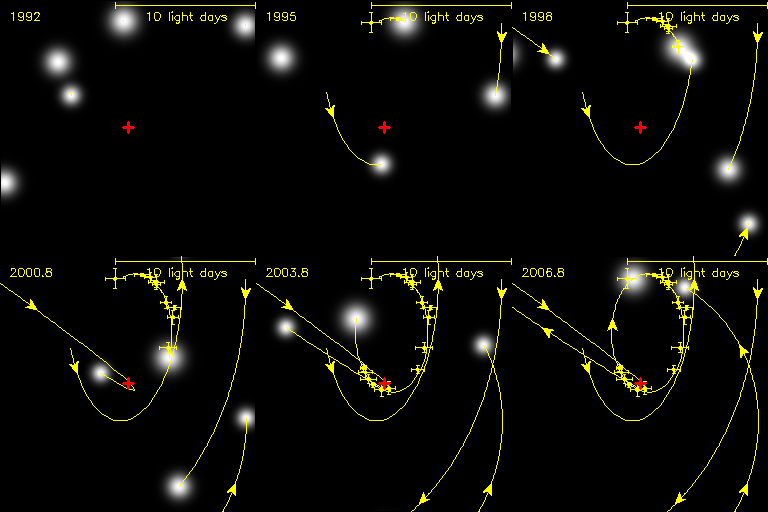
One nice example? The measurement of our Galaxy's central supermassive black hole.
Several groups have been able to measure accurately the mass of this black hole by tracking the movement of several stars around it.
In the animated GIF above, a nice illustration of the procedure. Every orbit is an ellipse having in one of its foci, marked by the red cross in the center of the picture, an "invisible" object. This object, in order to describe the orbits of all the tracked orbiting points, must have a mass of about 4 million solar masses.
Here is a quite complete description of the work done by several groups to obtain this result. 
Enjoy!


Friday, December 20, 2013

Medium-sized black holes? Probably not.

Ultraluminous X-ray sources (ULXs) are accreting black holes, i.e. black holes that are "eating" matter from a companion star. They are called ultraluminous because their luminosity is too high to be explained by "normal" accretion on stellar-mass black holes, i.e. black holes formed by the collapse of a single big star (from 8 up to ~100 masses of the Sun).
A step behind. During accretion, matter falls towards a central object. This matter heats up in the process, and this heat is freed in form of radiation. This radiation in turn "pushes" on the matter that keeps falling in, and a point is reached when the luminosity produced is comparable to the push by the infalling matter and so no higher luminosity can be achieved. This is called the Eddington luminosity and is a well known quantity in accretion studies. This luminosity scales with the mass of the central object, so that supermassive black holes (billions of times the mass of the Sun) will be able to radiate at much larger luminosities than stellar-mass black holes (mass several times the Sun)
Well, ULXs radiate at much more than the Eddington luminosity for stellar-mass black holes, so the first things that comes to mind is that they are bigger than stellar-mass black holes, and so they are members of the evasive class of Intermediate-mass black holes. Right?
Not so fast, my friend. People like these japanese researchers have done a great deal of simulations to show that it is possible to overcome the Eddington limit some extent.
Only problem: it was impossible to tell which of the two hypotheses was more right until 2012, since the few X-ray satellites capable of observing ULXs were sensitive only up to 10 keV, where the models started to really give incompatible predictions.
In this old post we talked about the launch of the NuSTAR satellite. Well, that was the turning point.
NuSTAR observed several ULXs and was able to finally strongly point in one direction. See the animated GIF above: the blue points are NuSTAR data, and they clearly follow better two models (the ones cutting off above 10 keV) than the others, while data from the XMM satellite weren't able to make a difference. This cutoff is considered a signature of super-Eddington accretion and permitted to estimate the mass of these ULXs to be in the high-end of the stellar-mass range.

Here is a press release of these studies. Enjoy!

Thursday, November 29, 2012

An over-massive black hole in the compact lenticular galaxy NGC 1277

A new survey recently reported in Nature found a supermassive black hole (mass~17 billions of solar masses) at the center of a relatively "light" galaxy. This wouldn't be a surprise if the mass of the black hole wasn't more than half the mass of the buldge of the hosting galaxy.


Figure 3: The correlation between black-hole mass and near-infrared bulge luminosity.
The black line shows the mass–luminosity relation for galaxies with a directly measured black-hole mass.
NGC 1277 is a significant positive outlier.
[taken from Nature]