Showing posts with label General Relativity. Show all posts

Friday, June 16, 2017

New Frontiers in Gravitational-Wave Astrophysics @ Sapienza

The workshop "New Frontiers in Gravitational-Wave Astrophysics" that will be held at Sapienza starting from next Monday.

Copyright: Michelangelo feat. coalescence

The list of speakers is impressive, the workshop will bring together leading experts in gravitational-wave astrophysics (the location surely helped attracting a lot of participants!), with the aim of discussing new frontiers, such as formation of black-hole binaries, multiwavelength and multimessenger astronomy, tests of gravity, neutron-star modelling and equation-of-state extraction from gravitational-wave signals.


Today, Valeria Ferrari, Leonardo Gualtieri and I are finally done with the organization, and I finally deserve this:

June in Rome & fresh beer, it could be worse....

Stay tuned for some news about the workshop later this week!


Wednesday, February 24, 2016

Onde Gravitazionali: la musica dello spaziotempo

Dopo l'incredibile rivelazione delle onde gravitazionali, gli amici dell'Associazione Astronomiamo mi hanno ricontattato per organizzare una serata online all'interno dei loro "Incontri di Astronomia". Ho accettato molto volentieri, visto il grande impegno ed entusiasmo che questa associazione mette nella divulgazione scientifica.

Ecco il video della serata, disponibile anche sul loro sito. Buona visione (specie per mia nonna!)


Thursday, February 18, 2016

Recommended by us: Time to move on?


''Cosmology and particle physics have long been dominated by theoretical paradigms: Einstein's general theory of relativity in cosmology and the Standard Model of particle physics. The time may have come for paradigm shifts. Does cosmological inflation require a modification of Einstein's gravity? Have experiments at the LHC discovered a new particle beyond the Standard Model? It is premature to answer these questions, but we theorists can dream about the possibilities.''
 

Full conference proceeding  here.

Monday, January 26, 2015

The Century of Strong Gravity

The following is a popular science article that Richard, Vitor and I have written for the IST Physics Magazine "Pulsar" (here is the Facebook page) and that will also appear in the Portuguese Physics Magazine "Gazeta de Fisica". A pdf version is available here (in English), and here (in Portuguese).


1. One Hundred Years of Gravity

The latest Christopher Nolan's movie, Interstellar, is about a future human civilization able to undertake cosmic travels to black holes using special shortcuts, ``wormholes''. Science-fiction as it might seem, Interstellar screenplayers --who happen to be the Nolan brothers-- have worked side by side with Kip Thorne, a professor of Theoretical Physics at the California Institute of Technology and one of the fathers of modern General Relativity, the theory that explains what wormholes and black holes are and how they form in the Universe.

Thorne's contribution is to ensure that the movie --starring Matthew McConaughey and Anne Hathaway among others-- doesn't contain scenes that would make Albert Einstein cringe.
Does this mean that travel agencies are about to sell (roundtrip!) tickets to a black hole? Not quite, but in a few years from now, theoretical physicists and astronomers will be able to study them as never before. The scientific payoff of these studies will largely overcome Interstellar's box-office, with all due respect to Mr. Nolan!


Thursday, March 7, 2013

Picture of the day: Hubble ha visto uno 'Space Invader'!!


Ricordate il famosissimo gioco "Space invaders!"? Probabilmente alcuni di voi sono troppo giovani per averci giocato ma sicuramente hanno chiara nella mente l'immagine delle "navicelle aliene" da abbattere!
Il gioco si basa su una struttura semplicissima ma efficace: il giocatore controlla un cannone mobile posto sul fondo dello schermo, che si muove orizzontalmente, e deve abbattere tutti gli alieni che piano piano si avvicinano alla Terra. Ora questa immagine ormai storica di questi alieni è stata osservata dal telescopio spaziale Hubble ed è stata diffusa, con il tono scherzoso, niente di meno che dal sito ufficiale della NASA.

Immagine distorta di una galassia a spirale che assume le fattezze degli alieni del famoso gioco "Space Invaders!". L'effetto è dovuto alla distorsione dei raggi luminosi provenienti dalle galassie sullo sfondo e che attraversano il fortissimo campo gravitazionale generato dall'ammasso di galassie chiamato Abell 68. L'immagine di una galassia a spirale è stata allungata e riflessa su un asse a causa dell'effetto "lente gravitazionale" previsto dalla teoria delle Relatività Generale di Einstein. Image Credit: NASA/ESA 

Monday, October 22, 2012

Recommended by us: gravitons


Gravitons

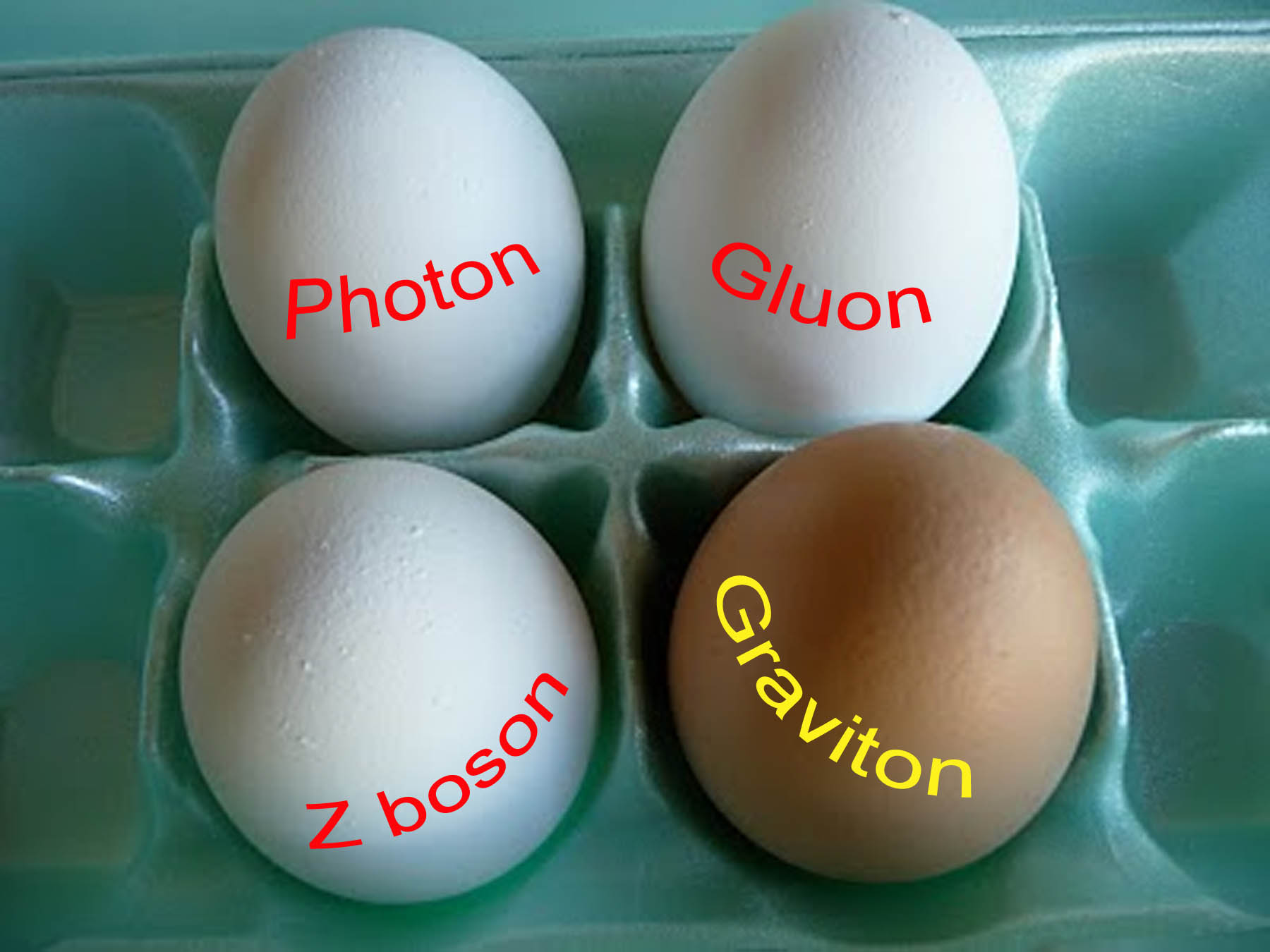
Sesame Street has a learning game that goes with the jingle "One of these things is not like the other. One of these things just doesn't belong." Can you find which one is different?
If you've read anything about the kinds of physics we do at Fermilab, you've heard lots of words ending with "on" – words like proton, neutron, gluon, photon, boson, fermion and on and on and on. One of the words you might have encountered is the graviton. Let's get one thing out of the way: At the moment, gravitons are entirely theoretical constructs that delicately walk the knife-edge precipice between the domains of scientific respectability and the shady world of hand waving.
The fantastic success of quantum theory to describe three forces – electromagnetism and the strong and weak nuclear forces – provides a considerable impetus to try to marry it to the fourth force of gravity. In the same way that the photon is known to be the quantum particle of the electromagnetic force and the gluon is the quantum particle of the strong force, the "graviton" is the name given to a hypothetical quantum particle of the gravitational force.
However, a quantum theory of gravity has so far been elusive. Einstein's theory of general relativity has been the most successful description of gravity, but when it encounters the quantum realm, it predicts nonsense, with impossible infinities popping up throughout the calculations. Infinities like that are nature's way of saying "back to the drawing board." And though theoretical physicists have quite a way to go in coming up with such a model, it is still possible to work out some of the properties of gravitons. (Continue to read on Fermilab Today)
                 ”