Showing posts with label black holes. Show all posts

Friday, June 16, 2017

New Frontiers in Gravitational-Wave Astrophysics @ Sapienza

The workshop "New Frontiers in Gravitational-Wave Astrophysics" that will be held at Sapienza starting from next Monday.

Copyright: Michelangelo feat. coalescence

The list of speakers is impressive, the workshop will bring together leading experts in gravitational-wave astrophysics (the location surely helped attracting a lot of participants!), with the aim of discussing new frontiers, such as formation of black-hole binaries, multiwavelength and multimessenger astronomy, tests of gravity, neutron-star modelling and equation-of-state extraction from gravitational-wave signals.


Today, Valeria Ferrari, Leonardo Gualtieri and I are finally done with the organization, and I finally deserve this:

June in Rome & fresh beer, it could be worse....

Stay tuned for some news about the workshop later this week!


Friday, March 17, 2017

Can exotic compact objects exist?

Spring is coming, restoring from hibernation, sorry for the long silence on this blog!

This week we have put a new paper out on the arXiv: Exotic Compact Objects and How to Quench their Ergoregion Instability, which is essentially the outcome of my student Elisa Maggio's master thesis, so I thought that summarizing our results was a good excuse to restart this blog.

Exotic compact objects (ECOs) is just a catchy name for several models that have been proposed as alternative to black holes. Black holes are the natural outcome of the gravitational collapse in classical general relativity, but a growing number of theoretical physicists is uneasy with some potential drawbacks associated with them, in particular with the consequences of forming an event horizon as the final state of the stellar collapse.

According to these arguments, the classical picture of black holes would be at clash with quantum mechanics, even for astrophysical objects for which, in principle, quantum corrections are expected to be small. Some of the potential problems include the famous information loss paradox, the recent firewall proposal, the huge entropy of a black hole, and the singularity that lurks in its interior, where general relativity has to break down. There is no general consensus on whether or not these are serious problems that should be addressed in the context of classical gravity, but a growing community of theoreticians is looking for alternatives.

In brief, models of ECOs aim at reproducing all properties of compact dark objects that we observe (namely, a radius very close to the Schwarzschild radius and an arbitrarily large mass) and the theoretical properties (stability, formation as the end state of physical astrophysical processes,...) that characterize the black hole dynamics but without having an event horizon nor a singularity. So far, none of the ECO models on the market succeeded in reproducing all these properties, which is already a strong result in support of the black hole picture. But we know that theoreticians are stubborn and they keep trying.

At the theoretical level, a possible problem with ECOs is the so-called ergoregion instability, an instability that develops in compact objects which are spinning fast and that, unlike a Kerr black hole, do not have a horizon. In this paper, we showed two things:

a) The instability is rather generic and quite strong when the ECO has a surface that does not absorb any radiation (like a perfectly reflecting mirror). Although apparently unrealistic, some quantum-gravity models predict precisely this situation, and might be ruled out by this effect.

b) If the ECO can absorb a fraction of the radiation in its interior (for example by converting it in heat and thermalizing the perturbation), then it is possible to quench the instability. Whether this makes the model viable or not depends on two crucial issues, that we don't address in the paper: a) Are there ECO models that absorb enough radiation to quench the instability? b) What's the final state of the instability?

It is likely that the answer to the latter question is that an unstable ECO would simply slow down as a result of the instability, until it's not unstable anymore. In such case, one should compare theoretical models with observations of highly spinning black hole candidates, to see whether the instability is incompatible with observations.

A lot of work remains to be done but this is surely an exciting time for this kind of studies. As I write this, I'm at Frankfurt airport on my way back after having attended this workshop. I have found great interest among the participants related to the possibility of ruling out or detecting ECOs using GW observations (see also this other recent paper), which was something unimaginable just a few years ago, before the gravitational-wave revolution.

Anyway, truth is, i wrote this to have the opportunity also to share some funny pics from Elisa's graduation last December :-)

Elisa going through the wormhole, she entered as an undergrad
and emerged from the throat as a grad student ready for her PhD
From the left: Leonardo, Elisa, and Paolo celebrating Elisa's defense

Friday, July 15, 2016

First results from Sardinia Radio Telescope

Are you going to visit Sardinia this summer?
If you arrive at the Airport of Cagliari from NE, probably you will see a strange 64-meter diameter white instrument
in the middle of (almost) nothing.


What it is that?  Keep calm: aliens are not arrived yet. Your holidays are probably save. 
This is the Sardinia Radio Telescope,
a major radio astronomical facility almost ready for outstanding scientific observations. 
Its science goals spread from Radio Astronomy, Geodynamical studies and Space science.

You do not trust me?
Here the  first scientific result from observations  with this extraordinary facility, published on
Monthly Notices of the Royal Astronomical Society:

https://arxiv.org/abs/1607.03636 

They observed a supermassive black hole 
moving at high velocity to a nearby galaxy cluster  3C129.
Here also a brief description of the obtained results from Matteo Murgia (in italian). 

Waiting for other exciting news from the SRT team! 


Thursday, June 16, 2016

Second detection of gravitational waves from a binary coalescence

Breaking news are all around the globe after yesterday's press conference by the LIGO/Virgo collaboration, which announced a second very solid gravitational-wave event on Boxing Day, Dec 26 2015, dubbed GW151226.

The waveforms of the 3 events detected by LIGO during O1 (the first observation run). GW150914 and GW151226 are events which are very solidly detected (at more than 5 sigma), whereas LVT151012 has a (small) probability of being a statistical fluctuation. From this page. The inspiral phase of the new event GW151226 lasted much longer than the original GW150914 (about 80 cycles in total)

I warmly suggest you to check this beautiful multimedia page, made by Marc Favata and his group.

As the LIGO/Virgo collaboration put it, the era of gravitational-wave astrophysics is officially started!


Wednesday, April 27, 2016

Can one hear the shape of a black hole? [*]

[Edit: see also the Synopsis in APS Magazine "Physics", the coverage and this interview (in Italian) by the Italian Institute for Astrophysics (INAF), and the stories in Physics World, NewScientistPhys.org, Le Monde and Repubblica.]


An orchestra conductor can easily tell a gong from a bell just by their different sound. Can astronomers do the same and tell a black hole from another dark object just by detecting their different gravitational-wave signal? In our recent paper, Vitor Cardoso, Edgardo Franzin and I show that this might not be the case [preprint here].


Last February, the LIGO/Virgo Collaboration announced the first direct detection of gravitational waves by the two laser interferometers advanced LIGO. This historical discovery has been also welcomed as the first conclusive proof for the existence of black holes, the most extreme objects in the Universe. The detected signal --dubbed GW150914-- corresponds to the "pas de deux" of two massive objects, which inspiral around each other and eventually collide in a cosmic spacetime-quake. LIGO data firmly show that the two objects are extremely compact and way too massive to be neutron stars. While providing compelling evidence, this does not represent a bullet-proof confirmation of the existence of black holes by itself. After all, signatures of compact, dark and massive objects come routinely from electromagnetic observations with infrared and X-ray detectors.

What makes GW150914 really unique is that the gravitational-wave signal contains all the final stages of the cosmic evolution of the binary system: the two objects lose an enormous amount of energy through the emission of gravitational waves, approach each other and eventually merge to form a single compact object of about 62 solar masses. After the merger (which lasted only a few milliseconds!) the final object was highly distorted and underwent an adjustment phase known as the "ringdown", in which the object vibrates pretty much like a drum. Just like the notes of the drum depend on its properties (the shape, the size, the material), the "ringdown modes" should carry information about the very nature of the final object produced after the merger.

A comparison between the ringdown signal of a particle falling into a black hole (black dashed line) and the same particle falling into a wormhole (red line). The wormhole geometry is illustrated in the top right corner. The two signals are identical at early times and the "universal" ringdown waveform is associated to the particle reaching point "A" (the light ring). The real quasinormal modes of the wormhole appear only at late times, when the particle reaches the throat (point "B").


Black holes are snatches in the spacetime fabric and their rim ---known as the event horizon--- vibrates in a very peculiar way that was predicted after decades of restless work by using Einstein's theory of general relativity. Scientists hope that, by detecting events like GW150914, one would be able to identify the modes of vibration of the final black hole (the so-called "quasinormal modes") from the ringdown signal. Detecting the quasinormal modes will be the definitive proof that black holes are produced in a binary merger, precisely as predicted by Einstein's theory.


In our recent work (selected as an Editor's Suggestion and featuring the cover of the current issue of Physical Review Letters), we show that this paradigm is incorrect. The vibrations of very compact objects without an event horizon are dramatically different from those of black holes (their frequency is lower and they last much longer time) and, nonetheless, the ringdown signal produced by these "black-hole mimickers" is identical to that of a black hole.


Wednesday, February 24, 2016

Onde Gravitazionali: la musica dello spaziotempo

Dopo l'incredibile rivelazione delle onde gravitazionali, gli amici dell'Associazione Astronomiamo mi hanno ricontattato per organizzare una serata online all'interno dei loro "Incontri di Astronomia". Ho accettato molto volentieri, visto il grande impegno ed entusiasmo che questa associazione mette nella divulgazione scientifica.

Ecco il video della serata, disponibile anche sul loro sito. Buona visione (specie per mia nonna!)


Thursday, February 11, 2016

Hey Grandma look: I finally study something that exists!

So much has been already written about today's announcement of the first direct discovery of the gravitational waves from two merging black holes by the advanced LIGO detector. Some examples:

[1], [2], [3] (this beautiful piece by my friend and colleague Emanuele Berti)

In Italian press: [1], [2], [3]

Exactly 100 years ago, Albert Einstein proved that his theory of gravity, General Relativity, predicted the existence of gravitational waves.


This is nothing but one of the most outstanding historic discoveries in science. However, since you can find much deeper posts on this topic, here are some random, not-so-serious, thoughts hastily written down while watching today's live streaming announcement (sorry for typos, this is written on the wings):

1) Look Grandma: I finally study something that exists!
[Last time someone told my grandma that maybe black holes didn't exist after all.. she literally cried!]

2) Wow, my field of research has finally become mainstream! [is this good of bad? Anyway, the largest lecture hall at the Physics Department at Sapienza was full 30 mins before the live streaming..that's pretty uncommon for something related to gravity...]

3) The first direct detection of gravitational waves is really great, but what is emitting these waves is even more interesting: these are two black holes orbiting each other, loosing energy through gravitational-wave emission and finally merging to form a final big black hole. All of this is beautifully predicted by Einstein's theory of General Relativity and required several decades of theoretical, experimental and computational work.

4) Now everyone claims they have predicted that the signal from a binary black hole merger would have been detected. Truth is, just 6 months ago nobody would have bet on this particular source.

5) Related to this, isn't it amazing how physics works? It takes just a single observation to completely change the paradigm that theorists have built over decades. Just 6 months ago very few people would have predict that LIGO -even in the case of a detection- would have been able to test General Relativity or just to make some science or astrophysics out of this discovery. Well, judging from the result of the paper published today (and the companion papers to come) this expectation was completely wrong.

6) Finally, my bets for the Nobel Prize (in random order)

Rainer Weiss, one of the founders of LIGO

Roy Kerr, who discovered the unique solution of General Relativity describing a spinning black hole

Kip Thorne, one of the cofounders of LIGO, and of the fathers of modern General Relativity
(plus one of the creator of the movie Interstellar)

Sunday, February 7, 2016

Visit to CERN

I am just back from CERN, where I stayed over this week to visit Diego Blas at the CERN THeory Division and to give the talk "Compact Objects as Dark-Matter Probes".

Some sparse thoughts on the visit:

1) On the first night, I checked in at a hotel in Geneva instead of staying at the CERN hostel. That was a very bad move. Everything in Geneva is unbelievable expensive and the hotel (albeit 3 star and averaged rated) turned out to be quite bad. I got bed bugs, i am still full of pinches, and i'm still trying to disinfect my clothes at home...

2) On the other hand, the hostel at CERN (where I stayed for the rest of the week) was excellent. The room was clean and cozy and equipped with a large desk. Everything at CERN seems to be designed to simply researchers' life and work.

3) I was impressed by the low average age of people working at CERN. About 10K work at the center and most of them are young PhDs or postdocs. The comparison with the average Italian university, where most of the faculty members and staff are over 40, is impressive. I recently read an interview by CERN Director Fabiola Gianotti, who was precisely commenting on this fact. However, experiencing it directly is a different kettle of fish.

4) Although CERN is big and experiments are scattered around a 27-km underground ring, I enjoyed the fact that most offices are located in a handful of buildings which are connected among each other. This basically means that theorists can chat over a coffee with experimentalists, or that it is easy to attend the (enormous) number of talks and lectures that are organized on a daily basis. The canteen is also common for all buildings and researchers from different collaborations and experiments meet there to have lunch (and sometimes dinner) together.

5) Overall, the atmosphere is definitely suggestive, even for someone like me who's used to see so many physicists in the same place (I guess that for the numerous students who regularly visit CERN during a school trip it must be really a unique experience).

6) I had the opportunity to meet various friends with whom I went to college in Cagliari (some of them are also authors of this blog). Funny enough, the excess of physicists from Cagliari University, especially in the LHCb experiment, is beyond 5 sigma. Thus, I had the opportunity to visit the LHCb experiment and control room, as this picture testifies:

Visit to the LHCb experiment. 
From the left to the right: Andrea (aka Scrilly), Francesco (both CERN Fellows) and me.

7) BTW, I also had the opportunity to hear more rumors around the 750 GeV diphoton resonance. Every theorist I talked to was extremely excited and sometimes confident about the possibility that ATLAS and CMS experiments have detected something new. Funny enough, every experimentalist I talked to was instead extremely cautious and, most of the time, pessimistic. I should definitely write about this in a next post but, as you probably have heard, this coming week the spotlight will all be on LIGO's announcement of the first direct detection of gravitational waves (!) No doubts on the topic of my next post (after Thursday).

Monday, January 18, 2016

AstronomiAmo

Domani saro' ospite della trasmissione web dell'Associazione AstronomiAmo  per parlare di "Stelle di neutroni e buchi neri come laboratori per la rivelazione di materia oscura".

La serata e' condotta da Stefano Capretti e sara' trasmessa in diretta sulla pagina web dell'associazione e sul canale Youtube, nel quale trovate tutte le trasmissioni precedenti e che vi invito caldamente a seguire.

Appuntamento domani, Martedi' 19 Gennaio alle 21:30.

La locandina dei prossimi eventi online organizzati dall'Associazione AstronomiAmo.

Aggiornamento: Ecco il video della serata


Thursday, June 25, 2015

Summer Reading

Last year was "Fifty shades of Grey". This summer --no matter if you are sunbathing, hiking or enjoying desolated cities-- if you start pondering about black holes, superradiance, and related subjects, we got you covered:

The book will be soon available on the Springer webpage and on Amazon. Hurry up to buy a copy containing the typo in Vitor's name before they fix it. Those copies will be priceless hundred years from now :)

The book will be available in August but can be already pre-ordered. It costs $60 in the U.S. and about 45 Euros in Europe and the authors get about the 10% of the profit. This means that each of the authors (Richard, "Victor" and I) will get about 3 Euros for each sold copy. Taking "50 shades of Grey" as a reference, a back-of-the-envelope estimate suggests we might become rich in ~10^9 years.

Friday, January 30, 2015

Two Supposedly Fun Things I'll Never Do Again

Writing a review is like pregnancy (as far as I can imagine being pregnant and with due respect to real mothers...), one starts super-excited, then begins to realize the initial expectations were too optimistic and that the entire experience is going to be much tougher than originally expected; and while the "baby" is growing, everything becomes tougher and tougher, to the point that one starts looking forward to the delivery (and THAT is probably the toughest part).

This is why finishing two reviews (here and here) in the same week is pretty much like having a twin childbirth, and now I feel like one of those exhausted mothers who stares at their babies with extreme joy.


For those who missed the reference in the title, one of the best books ever..nothing less than a must-read! 


The first work is an overview on superradiance. [If you are curious about what superradiance is... well, read the book! Meanwhile, in very few words superradiance is a broad class of phenomena related to energy amplification in dissapative systems. Because of dissipation, in special kinematic configurations the energy stored in some body/medium can be transferred to another body or to radiation, thus producing a sort of amplifier].


Monday, January 26, 2015

The Century of Strong Gravity

The following is a popular science article that Richard, Vitor and I have written for the IST Physics Magazine "Pulsar" (here is the Facebook page) and that will also appear in the Portuguese Physics Magazine "Gazeta de Fisica". A pdf version is available here (in English), and here (in Portuguese).


1. One Hundred Years of Gravity

The latest Christopher Nolan's movie, Interstellar, is about a future human civilization able to undertake cosmic travels to black holes using special shortcuts, ``wormholes''. Science-fiction as it might seem, Interstellar screenplayers --who happen to be the Nolan brothers-- have worked side by side with Kip Thorne, a professor of Theoretical Physics at the California Institute of Technology and one of the fathers of modern General Relativity, the theory that explains what wormholes and black holes are and how they form in the Universe.

Thorne's contribution is to ensure that the movie --starring Matthew McConaughey and Anne Hathaway among others-- doesn't contain scenes that would make Albert Einstein cringe.
Does this mean that travel agencies are about to sell (roundtrip!) tickets to a black hole? Not quite, but in a few years from now, theoretical physicists and astronomers will be able to study them as never before. The scientific payoff of these studies will largely overcome Interstellar's box-office, with all due respect to Mr. Nolan!


Sunday, January 4, 2015

Workshop: "Compact Objects as Astrophysical and Gravitational Probes" at the Lorentz Center (Feb 2-6, 2015)

It's a pleasure to advertise the workshop  "Compact Objects as Astrophysical and Gravitational Probes", to be held at the Lorentz Center (Leiden, The Netherlands) from February 2 through February 6.

One version of the workshop's poster, the official one will soon appear in the official webpage.
Here young Subrahmanyan Chandrasekhar and Albert Einstein are looking towards the most urgent questions in relativistic astrophysics, a field that has essentially emerged from their seminal works. The two young guys respectively symbolize the astrophysical and the general-relativistic communities that will gather together at this workshop, to share expertize and try to fill the gap between them
.
Last June, Enrico Barausse (at the Institut Astrophysique de Paris), Tamara Bogdanovic (at Georgia Tech in Atlanta), Vitor Cardoso (at CENTRA - Instituto Superior Tecnico in Lisbon) and Elena Maria Rossi (at Leiden University in the Netherlands) and myself have applied to an international call at the Lorentz Center to organize a workshop. We initially had in mind a small-size workshop with ~20 participants, but the proposal was selected for a large-size event. Thus, in less than one month, more than 50 world-leading experts in relativistic astrophysics will gather together in what will hopefully be a fruitful and exciting meeting (here is the program and at list of participants).


Saturday, November 15, 2014

Interstellar

 "Honestly, Interstellar really sucks" -- this is not quite true, but I couldn't help thinking of this scene.


When I asked my spouse whether she would come to watch latest Christopher Nolan' movie Interstellar, she replied: "No way!".

"But it's about black holes.", I said.
"Exactly." - she replied.

"But Kip Thorne, a world-famous physicist, was involved in the production.", I said.
"Even more so." - she replied.

"But the director is Christopher Nolan!", I replied.
"Indeed."

"But it's gonna be a Hollywood Blockbuster!", I continued
"Forget about it"

"But it's the movie of the year!"
"Exactly."

That was the end of the conversation. As a matter of fact, she went to watch the movie without (and even before!) me, but I guess this is normal within women logic.

Anyway, together with part of the Lisbon gang, yesterday we finally went to watch Interstellar in its iMAX curved-spacetime, relativistic glory, so now we too are entitled to talk about this movie.


Thursday, April 24, 2014

The first observed SMBHB?

An artistic illustration of black hole
SMBHB stands for Super Massive Black Hole Binary. If the results get confirmed, this shows that we have observed inactive SMBHBs for the first time ever! SMBHs can be 10^7 times more massive than our own Sun. The Sun is one million times more massive than the Earth. The mass of Earth is about 10^24 kg, by the way.

SMBHBs can be used as excellent natural labs for testing many aspects of gravitational and high-energy physics. As you might know already or might just guess from the term "black hole", a black hole cannot be seen by our usual optical telescopes (not even by other common types of telescopes in other ranges of frequencies of electromagnetic waves such as radio-telescopes and x-ray telescopes). A black hole is such a massive object that even light cannot scape from its gravitational field. That’s also why you can not see a black hole, simply because neither light nor other electromagnetic waves can scape from the gravitational field of a black hole and reach your eyes. The only way to observe black holes is studying their gravitational field effect on the motion of nearby stars. An even better way to study and observe these inconspicuous giants is listening to them! (check out this note to see how) They are pretty loud!

To check out more details about this first serious candidate of SMBHB at the galaxy SDSS J120136.02+300305.5, see the original article, published recently at The Astrophysical Journal: F. K. Liu et al. 2014 ApJ 786 103.

Thursday, March 20, 2014

Paper of the day: "Damn it! Why wasn't me to write this??"

One of my favorite songwriters, now retired Francesco Guccini, wasn't used to sing pieces written by other authors. One of the rare occasions in which he decided to do so is this one:


where he sings Roberto Vecchioni's "Luci a San Siro". Guccini's incipit starts by saying some like 

"The song I am going to sing is titled: - Damn it! Why wasn't me to write this song? 

... Well, the paper I am going to review today is titled"

"Damn it! Why wasn't me to write this paper?"

The paper I am referring to appeared some days ago on the arXiv,


it is written by Carlos Herdeiro and Eugen Radu from the University of Aveiro. I have to admit it, this paper is just beautiful. Seriously. Not only the result circumvents one of the classical theorems of General Relativity [the black hole no-hair theorem, see below] but, in doing so, it also connects elegantly two solutions which were previously thought to be very different. As if that was not enough, it is beautifully written in such a way that the overall feeling is the one that only great papers can give -- a feeling that only scientists have the privilege to appreciate [and possibly artists can do so too, while watching/listening to//performing other colleagues' pieces of arts as in the video above]. 

Wednesday, February 12, 2014

You can sleep soundly: we will not be devoured by a black hole

Today Público, one of the main Portuguese daily newspaper, published a very nice piece on our group in Lisbon, talking about our recent paper and the group's supercomputer Baltasar Sete-Sóis.

Overused pictorial description of a black hole #4


PS:
Why the long silence? Four (4) requests to referee received in 3 days (2 reports submitted, 2 to go), moved back to Lisbon 1 week ago, found new apartment, wrote 3 financial and scientific reports for my past fellowship, did paperwork for a new contract, prepared a talk i'm giving in 30 mins, read a Master thesis, trying to write a proposal and at the same time also trying to work (for real) and...live!

Thursday, December 26, 2013

Measuring a black hole mass - you're doing it right


  1.  The orbit of every planet is an ellipse with the Sun at one of the two foci.
  2. A line joining a planet and the Sun sweeps out equal areas during equal intervals of time.
  3. The square of the orbital period of a planet is proportional to the cube of the semi-major axis of its orbit.
Kepler's laws are among the most fundamental laws of astronomy.
Basically, they describe the orbits of planets around the Sun (or any "small" object around a much more massive central object), under the assumption that the gravitational field can be considered Newtonian (even if historically quite the opposite happened, with Newton using Kepler's orbits to derive his laws of gravity).
The orbits of all planets in the Solar system are very well described, to first order, by these laws. Only after centuries of observations of Mercury, the closest to the Sun, it was possible to notice post-Keplerian deviations due to relativistic effects.
When Kepler's laws say "proportional", the proportionality factor involves the masses of the objects (this was found by Newton). For example, in this approximation the third law is actually
where a is the semi-major axis of the orbit (the radius if the orbit is circular), G (=6.67384 × 10⁻¹¹ m3 kg-1 s-2) the gravitational constant, M the mass of the central object, and T the orbital period.
It is therefore possible to use the orbit of the small object to infer the mass of the big one, if we have an idea of the size of the orbit.

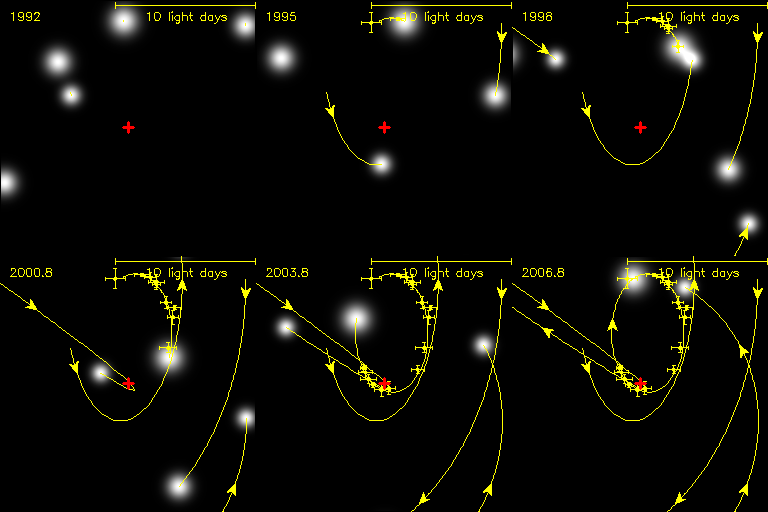
One nice example? The measurement of our Galaxy's central supermassive black hole.
Several groups have been able to measure accurately the mass of this black hole by tracking the movement of several stars around it.
In the animated GIF above, a nice illustration of the procedure. Every orbit is an ellipse having in one of its foci, marked by the red cross in the center of the picture, an "invisible" object. This object, in order to describe the orbits of all the tracked orbiting points, must have a mass of about 4 million solar masses.
Here is a quite complete description of the work done by several groups to obtain this result. 
Enjoy!


Friday, December 20, 2013

Medium-sized black holes? Probably not.

Ultraluminous X-ray sources (ULXs) are accreting black holes, i.e. black holes that are "eating" matter from a companion star. They are called ultraluminous because their luminosity is too high to be explained by "normal" accretion on stellar-mass black holes, i.e. black holes formed by the collapse of a single big star (from 8 up to ~100 masses of the Sun).
A step behind. During accretion, matter falls towards a central object. This matter heats up in the process, and this heat is freed in form of radiation. This radiation in turn "pushes" on the matter that keeps falling in, and a point is reached when the luminosity produced is comparable to the push by the infalling matter and so no higher luminosity can be achieved. This is called the Eddington luminosity and is a well known quantity in accretion studies. This luminosity scales with the mass of the central object, so that supermassive black holes (billions of times the mass of the Sun) will be able to radiate at much larger luminosities than stellar-mass black holes (mass several times the Sun)
Well, ULXs radiate at much more than the Eddington luminosity for stellar-mass black holes, so the first things that comes to mind is that they are bigger than stellar-mass black holes, and so they are members of the evasive class of Intermediate-mass black holes. Right?
Not so fast, my friend. People like these japanese researchers have done a great deal of simulations to show that it is possible to overcome the Eddington limit some extent.
Only problem: it was impossible to tell which of the two hypotheses was more right until 2012, since the few X-ray satellites capable of observing ULXs were sensitive only up to 10 keV, where the models started to really give incompatible predictions.
In this old post we talked about the launch of the NuSTAR satellite. Well, that was the turning point.
NuSTAR observed several ULXs and was able to finally strongly point in one direction. See the animated GIF above: the blue points are NuSTAR data, and they clearly follow better two models (the ones cutting off above 10 keV) than the others, while data from the XMM satellite weren't able to make a difference. This cutoff is considered a signature of super-Eddington accretion and permitted to estimate the mass of these ULXs to be in the high-end of the stellar-mass range.

Here is a press release of these studies. Enjoy!