Showing posts with label MINOS. Show all posts

Sunday, June 8, 2014

Vita dura per i neutrini sterili e non solo


Si è appena conclusa a Boston la conferenza NEUTRINO2014 dedicata, così come vuole il nome, ai nuovi risultati sperimentali e teorici che provengono dal mondo di queste elusive e misteriose particelle, per l’appunto, i neutrini.

Ci sono parecchie novità interessanti e volevo quindi fare un piccolo riassunto sulle cose più sfiziose.

Partiamo dalla ricerca dei cosiddetti neutrini sterili, e cioè di quelle particelle ipotetiche che sono state introdotte per spiegare alcune anomalie riscontrate nel corso degli anni da alcuni esperimenti che non si inquadravano nel modello delle oscillazioni a tre neutrini. Il primo esperimento a riscontrare un’anomalia è stato LSND (Liquid Scintillator Neutrino Detector) a Los Alamos, in cui è stato registrato un eccesso di antineutrini elettronici, con significatività di 3.8 sigma, su un fascio pressoché puro di antineutrini muonici. Se interpretati in uno schema di oscillazione a due neutrini, per la particolare configurazione della baseline, L, (la distanza tra sorgente di neutrini e rivelatore) e l’energia, E, da cui dipendono la probabilità di oscillazione di un neutrino muonico ad uno elettronico \[ P_{\nu_{\mu}\rightarrow\nu_{e}}\left(L,\, E\right)=\sin^{2}2\vartheta_{e\mu}\sin^{2}\left(1.267\:\frac{\Delta m_{41\,}^{2}L}{E}\right) \] questo eccesso sarebbe indicativo di un'oscillazione con una piccola ampiezza e un grande \(\Delta m^{2}\sim1\) \(\textrm{eV}{}^{2}\). Appare chiaro che un \(\Delta m^{2}\sim1\) \(\textrm{eV}{}^{2}\), non può essere incorporato in un modello a tre soli neutrini (elettronico, muonico e tauonico) in cui esistono solamente due differenze di masse al quadrato indipendenti. Infatti deve valere la relazione \[\Delta m_{21}^{2}+\Delta m_{32}^{2}+\Delta m_{31}^{2}=m_{2}^{2}-m_{1}^{2}+m_{3}^{2}-m_{2}^{2}-m_{1}^{2}-m_{3}^{3}=0\,\] e dal momento che la differenza di massa al quadrato dei “neutrini solari” è \(\Delta m_{SOL}^{2}=\Delta m_{21}^{2}=7.58_{-0.26}^{+0.22}\times10^{-5}\) \(\textrm{eV}{}^{2}\) e di “quelli atmosferici” è \(\Delta m_{ATM}^{2}=\left|\Delta m_{31}^{2}\right|\simeq\left|\Delta m_{32}^{2}\right|\simeq2.35_{-0.09}^{+0.12}\times10^{-3}\) \(\textrm{eV}{}^{2}\), non vi è spazio per una differenza di massa al quadrato dell'ordine dell'\(\textrm{eV}{}^{2}\), se non in uno schema in cui sia presente almeno un nuovo stato di neutrino massivo \(\nu_{4}\) sterile, per cui possa essere interpretata la differenza di massa al quadrato come \(\Delta m_{\textrm{new}}^{2}\equiv m_{4}^{2}-m_{1}^{2}=\Delta m_{41}^{2}\). Questo neutrino però deve essere sterile, e quindi non deve partecipare a nessuna delle interazioni (tranne quella gravitazionale) in quanto esistono delle misure effettuate al LEP sul decadimento del bosone Z in neutrini, che indicano che il numero di neutrini “attivi” (e cioè quelli che interagiscono per forza debole) deve essere esattamente tre.

Monday, March 18, 2013

Recommended by us: Neutrinos and non-standard interactions


Does matter matter for neutrino flavor?


The NuMI (Neutrinos at the Main Injector) beam is generated here at Fermilab and points toward the Soudan Underground Laboratory in Soudan, Minn. The MINOS collaboration detects this beam of neutrinos in its journey twice: once at Fermilab right after it is generated and once at Soudan Lab after the neutrinos have traveled 450 miles through the Earth's crust. At its generation, the beam is made up of muon-flavored neutrinos (neutrinos come in three flavors: electron, muon, and tau). After traveling such a long distance, some of the neutrinos change flavor, primarily into tau neutrinos and a few into electron neutrinos. This phenomenon of flavor change is called neutrino oscillation. By counting the number (and measuring the energy) of muon neutrinos before and after travel, MINOS can measure parameters that govern neutrino oscillations.

            The presence of matter in the neutrino path may also have an impact on flavor change. If it does, the flavor 
            count after travel would be altered. Some of these interactions are expected from the tiny number of oscillation
            generated electron neutrinos, but extra interactions of muon or tau neutrinos with the Earth are non-standard and
            are thus called non-standard interactions, or NSI for short. (The Earth is made up of regular matter—electrons, 
            protons and neutrons—and not of matter in muon or tau flavors.)

By combining its neutrino and antineutrino data sets, MINOS has constrained the non-standard interaction parameter εμτ, finding that the results are consistent with εμτ=0, shown by the gray line. The angle θ and the parameter Δm2 relate to the relative masses of the neutrinos and to how quantum mechanically "mixed" the flavors are.

                                                                                              (Continue to read on Fermilab Today)
                 ” 

Saturday, January 19, 2013

Recommended by us: Organizing the masses at MINOS

Organizing the masses at MINOS


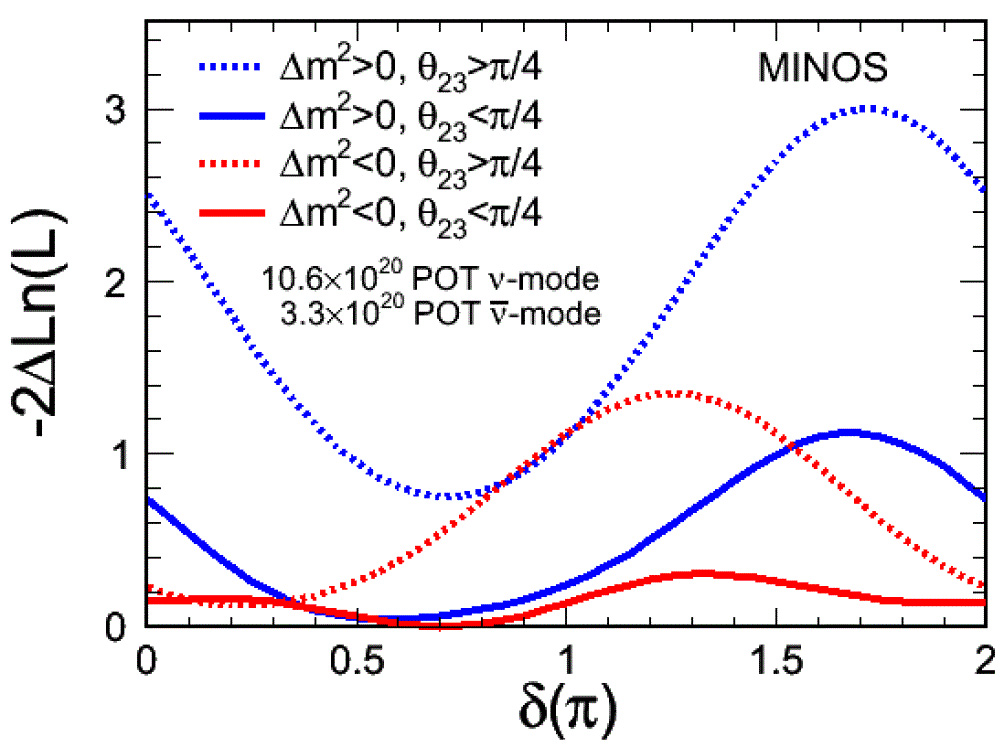
By combining its neutrino and antineutrino data sets, 
MINOS  has  provided first constraints on the spectrum 
of neutrino masses (represented by the sign of Δm2), the 
CP-violating phase δ,and whether muon or tau neutrinos 
are more strongly mixed  with the so-called ν3 mass state 
(indicated by θ23). The relative goodness of each scenario
 is given along the vertical axis in terms of a difference of 
log-likelihoods. The parameter Δm2 and the angles θ13 
and θ23 relate to the relative masses of the neutrinos and
to how quantum mechanically "mixed" the three types are.
Over a decade ago the evidence became clear that neutrinos, which come in three varieties, can morph from one type to another as they travel, a phenomenon known as neutrino oscillation. By tallying how often this transformation happens under various conditions—different neutrino energies, different distances of travel—one can tease out a number of fundamental properties of neutrinos, for example, their relative masses. The MINOS collaboration has been doing exactly this by sending an intense beam of muon-type neutrinos from Fermilab to northern Minnesota, where a 5-kiloton detector lies in wait deep underground.

In this new result, MINOS has observed the rare case of muon-type neutrinos changing into electron-type neutrinos. This transformation is governed by a parameter known as θ13, and the MINOS data provide new constraints on θ13 using different experimental techniques than previous measurements. MINOS also collected data with an antineutrino beam, and the real excitement comes in when combining the antineutrino and neutrino data sets. Differences between the rates of this particular oscillation mode between neutrinos and antineutrinos would point to a violation of something called CP symmetry. While physicists know that CP symmetry is violated by quarks, it remains unknown whether the same is true for neutrinos. A new source of CP violation is required to explain why the universe began with more particles than antiparticles, and neutrinos could hold the key. (If the universe began with equal numbers of particles and antiparticles, they would have subsequently annihilated away, leaving nothing left over to make the stars and galaxies we have today.)
                                                                                                       (Continue to read on Fermilab Today)
                    ”